

FIFA is pushing the boundaries of football technology by testing systems designed to determine whether a ball has gone out of play and to improve offside decisions. These innovations were trialed during the FIFA Intercontinental Cup 2025 in Qatar and are aimed at reducing human error, speeding up refereeing decisions, and enhancing fairness in the game.
The “Out of Bounds” technology is one of FIFA’s latest initiatives to ensure accurate goal-line and touchline decisions. This system tracks the ball in real time and can detect if it has completely crossed the goal line or the sidelines before a goal or continuation of play. The technology was tested in three Intercontinental Cup matches in Qatar and uses the same advanced tracking data points and configurations as semi-automated offside systems.
By providing instant confirmation to referees, this technology aims to reduce the number of controversial calls, such as goals that may have involved a ball out of play. It offers both referees and VAR officials a reliable tool for situations that were previously difficult to judge, even with multiple camera angles.
In addition to out-of-play detection, FIFA has expanded the use of “Real-Time 3D Recreation” to assist in offside decisions. This technology creates virtual perspectives from both goalkeepers’ viewpoints, giving referees and TV viewers a clear picture of line-of-sight situations.
The system is designed to minimize the delays and errors associated with traditional offside judgments. Furthermore, FIFA is testing immediate audio alerts to VAR assistants, which notify them instantly of offside infractions. This could reduce delayed or missed flags, ensuring the game continues fairly and efficiently.
Historical Controversies Highlight the Need
Several high-profile incidents in domestic leagues underscore why such technology is essential:
- In the Premier League, two seasons ago, Arsenal contested Anthony Gordon’s goal for Newcastle after VAR could not confirm if Joe Willock had kept the ball in play.
- In another recent incident, claims arose that Leandro Trossard blocked Guglielmo Vicario’s line of sight during Eberechi Eze’s goal for Arsenal.
- During the Intercontinental Cup final, Paris St-Germain’s Fabian Ruiz had a goal ruled out because the ball went out of play.
These examples highlight how advanced tracking and 3D visualization could have provided clarity, ensuring accurate rulings and reducing controversy.
FIFA is also prioritizing player safety with this technology. In May, Nottingham Forest striker Taiwo Awoniyi suffered a severe injury after colliding with a goalpost during a play that continued despite a clear offside. Faster offside alerts and precise ball tracking could prevent such incidents in the future. By reducing uncertainty in decisions, players can rely on safer gameplay without risking collisions caused by delayed calls.
Although currently tested in FIFA competitions, the technology could eventually be rolled out to domestic leagues. Implementing it widely would allow leagues to reduce controversial decisions, increase referee confidence, and enhance the overall fan experience. Fans could also benefit from virtual feeds showing real-time decisions from goalkeeper perspectives, bringing greater transparency to matches.
Expert Opinions
Hawk-Eye Innovations, in collaboration with FIFA, developed these systems to provide referees with actionable insights. Analysts believe that combining out-of-play detection with real-time 3D offside recreation could revolutionize football officiating. By integrating these tools, referees can focus on managing the match, while technology ensures fairness and accuracy.
How the Technology Works
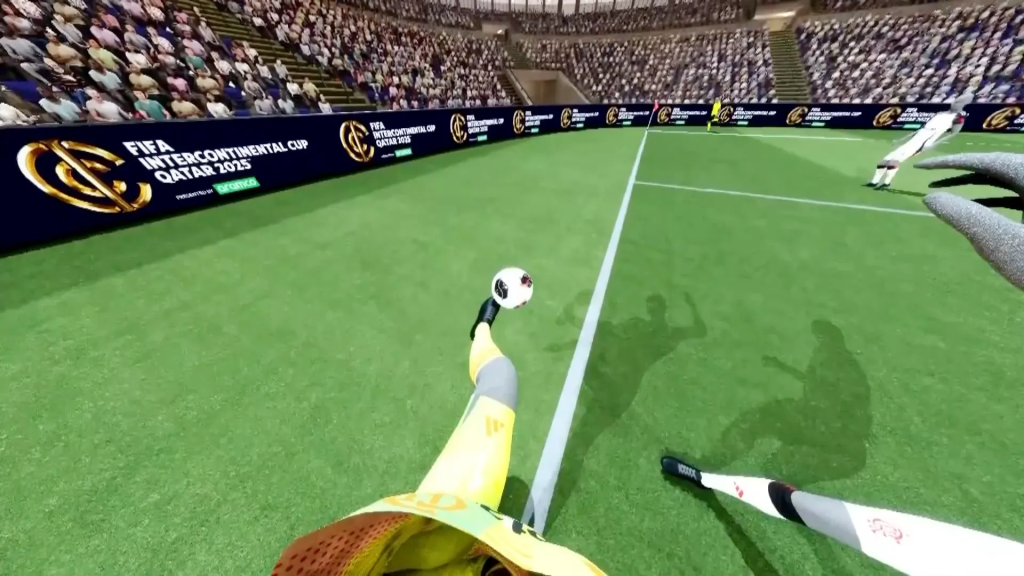
- Ball Tracking: Uses advanced sensors to determine if the ball has completely crossed the line.
- Virtual Feeds: Replicates the viewpoints of both goalkeepers to assist VAR in offside decisions.
- Audio Alerts: Sends instant notifications to VAR officials about potential offside situations.
- Offline and Live Testing: Initially tested in controlled and match environments to ensure reliability.
If adopted widely, this technology could significantly reduce the number of controversial moments in football. Referees would be able to make quicker and more precise decisions, while teams and players would benefit from clarity and fairness. Fans could enjoy matches without confusion or prolonged disputes over goals and offsides. Additionally, by improving decision speed, the flow of the game would be less disrupted.
FAQs
Q1: What is FIFA’s Out of Bounds technology?
A: It is a system that tracks the ball and determines if it has fully crossed the goal line or touchline before a goal is scored.
Q2: How does Real-Time 3D Recreation work for offsides?
A: It creates virtual perspectives for VAR and TV viewers, simulating the line of sight of both goalkeepers to ensure accurate offside calls.
Q3: Are these technologies available in domestic leagues yet?
A: Currently, they are being tested in FIFA tournaments. Adoption in domestic leagues will depend on evaluation results.
Q4: How does FIFA aim to improve player safety?
A: By providing quicker offside alerts and accurate ball tracking, referees can prevent dangerous plays that could lead to serious injuries.
Q5: Who developed the new FIFA technologies?
A: FIFA partnered with Hawk-Eye Innovations to develop and test these systems.
Q6: What controversies could this technology solve?
A: It could clarify disputed goals, line-of-sight offside situations, and reduce delays in VAR decisions, making football more fair and transparent.